





Forging a Stronger Farmers’ Movement in Tanzania

Hundreds of farmers organized in MVIWATA gathered in Morogoro, Tanzania for their AGM in early December, 2025. Photo: MVIWATA
Over 670 farmers gathered in Morogoro, Tanzania, on December 4-5 to chart a course for the future of MVIWATA (National Network of Farmers Groups in Tanzania), one of Africa’s most unique farmers’ organizations. The occasion was MVIWATA’s 30th Annual General Meeting (AGM), which serves as the highest democratic platform for members to voice their aspirations for the organization’s future.
As the powerful slogan, “Mviwata, Sauti ya Mkulima” (MVIWATA is the voice of the farmer) and “Mtetezi wa Mkulima, Mkulima Mwenyewe” (The defender of the farmer is the farmer), rang through the hall time and again, the farmers debated and arrived at conclusions on strengthening their networks in concrete ways.
The AGM opened with a vibrant performance by local MVIWATA cultural groups, featuring energetic dance and powerful lyrics that called for the unity of farmers. This was followed by an acknowledgement of those who had recently lost their lives in the aftermath of the disrupted elections. A collective occasion, the event aimed to define strategies, reinforce solidarity, and reclaim the farmer’s role as the protagonist of Tanzania and the backbone of the national economy.
On the opening day, National Chairperson Apollo Chamwela and Executive Director Stephen Ruvuga stressed the urgent need for solutions rooted in farmer-to-farmer solidarity and a clear understanding of the peasants’ role in Tanzania. Ruvuga highlighted how the global “value chain” marginalizes peasants: they are the primary food producers, yet earn a pittance from valuable cash crops like coffee and cashews. At the same time, agribusiness and middlemen reap huge profits. He concluded: “We are producing a lot of wealth but getting only a slice of it while the benefits only go to those who don’t even know how to farm.”
The crisis is not restricted to markets and prices. Every phase of agriculture is affected. Whether it be synthetic fertilizers or seeds, four to five companies control the market. “A dependence on inputs we don’t produce by ourselves enriches the system that benefits a few and reduces the peasant to a mere buyer,” Ruvuga said, linking MVIWATA’s core concept of self-reliance to the everyday needs of farmers.
MVIWATA Chairperson Apollo Chamwela emphasized that the commitment of delegates – many of whom traveled vast distances (over 2,000 kilometers from regions like Kagera) and financed their own attendance – was a key organizational milestone. This commitment, where farmers use their own resources and do not depend on the organization for travel, signifies genuine self-reliance and a deep sense of ownership: “This organization is ours!” Chamwela added that by actively engaging in the AGM, farmers reinforce MVIWATA as a vital platform used “like a weapon to fight for their rights.”
For over 30 years, MVIWATA has organized farmers to practice self-reliance, especially through agro-ecological farming techniques that enable higher quality production with fewer dependencies. MVIWATA’s foundational philosophy is deeply rooted in the principles of Julius Nyerere’s Ujamaa and self-reliance. By organizing farmers into cohesive, democratic networks to mutually aid one another in production, marketing, and savings, MVIWATA embodies the spirit of self-determination articulated by Nyerere in the 1967 Arusha Declaration. This focus on local, collective ownership and the deliberate resistance to external capitalist dependencies directly reflects the Ujamaa ideal of building an equitable, independent society in which the people – specifically the peasantry – are the protagonists of their own path forward.
However, MVIWATA’s mission does not end there.
Networks of farmers aid and assist each other in seed development, getting better prices for their crops, building markets, enabling savings schemes, and organizing to prevent and resist efforts to take away their land. From farmers cultivating rice and maize to pineapples, bananas and mangos, and spices like cinnamon and cloves, MVIWATA has, through a process of popular consultation, come up with strategies for all.
Vibrant debates and concrete pillars for a stronger 2026
Intense discussion among delegates, in both group and plenary sessions, was the highlight of the AGM, resulting in concrete strategic pillars for organizational growth and increasing members’ abilities in several key areas in 2026. The consensus focused on strengthening self-reliance, both in farming techniques and organizational management.
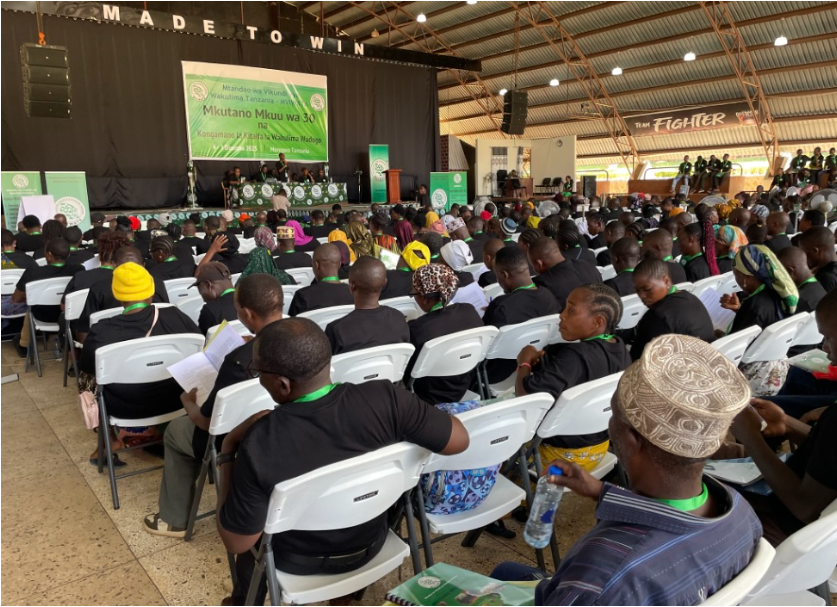
Members of MVIWATA participate in the AGM. Photo: MVIWATA
Hundreds of farmers from across the country participated and contributed concrete proposals such as developing natural herbicides and pesticides, and expanding training programmes to increase awareness of agro-ecological practices. A dedicated discussion focused on the question of reconciling traditional landholding patterns to contemporary legal requirements.
The AGM featured a rigorous debate on establishing the organization’s own financial institution. Building on existing local-level capital access schemes, delegates emphasized the urgent need for a more sophisticated, wide-reaching instrument capable of providing loans at reasonable rates and at the necessary junctures to fully serve farmers.
The discussions also stressed the need for training and education, both through farmer-led sessions and MVIWATA FM, the organization’s radio station that serves as a vital tool for highlighting farmers’ voices, unlike mainstream media, which ignores the peasant agenda. Many of the ideas presented by farmers formed key pillars of the organization’s plan for the coming year, announced on December 5.
For Odilia J. Bernad, who has been a member of MVIWATA for nine years, the AGM was “like a school.” She added, “We divided ourselves into groups. There were young people, women, and the elderly, and we sat and discussed our activities and explained the challenges we faced in our regions with a focus on solving them.” The farmer is the bread-winner of the country, she noted, saying that it was essential that farmers have a strategic plan for the coming year. “Farmers must evaluate themselves to see where they came from, where they are, and where they are heading. And if there are mistakes made in the previous year in the strategic plans, they should see what they can do to achieve their goals for the next year.”
Michael Mbago, a farmer who cultivates maize, cassava and yams and has been a veteran of MVIWATA for over 15 years, echoed the sentiment. For him, MVIWATA’s success lay not just in addressing agricultural issues but in educating people about the political, economic, and social aspects. MVIWATA has become a refuge for many small farmers, he said, adding that it will be vital in helping them “achieve victory” in various aspects of farming.
The unity forged at the 30th MVIWATA AGM gave farmers the confidence to meet the demands of the struggle in 2026 and to continue building a stronger farmers’ movement in Tanzania. As summarized by Chairperson Apollo Chamwela: “The struggle we are in needs unity of farmers, across Tanzania, Africa and the world. The defender of the farmer is the farmer.”
Courtesy: Peoples Dispatch
Get the latest reports & analysis with people's perspective on Protests, movements & deep analytical videos, discussions of the current affairs in your Telegram app. Subscribe to NewsClick's Telegram channel & get Real-Time updates on stories, as they get published on our website.