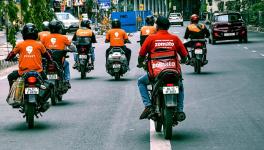






Gig Workers, Delivery Partners Strike on Christmas Day, Work 'Affected' in 7 States

New Delhi: On the call of the Gig & Platform Service Workers Union (GIPSWU), food and other app-based “delivery partners” went on a “national strike” on December 25 (Christmas Day) demanding the right to “safety, security and dignity”.
A press statement issued by GIPSWU said the strike made an impact in Delhi, Haryana, Rajasthan, Maharashtra, Karnataka and Uttar Pradesh.
Seema Singh, president of GIPSWU, said the union’s core committee would soon seek a meeting with the Labour Minister, to discuss the issues faced by gig and platform workers.
“Platform-based delivery partners today operate under conditions where earnings are determined entirely by non-transparent automated systems, without transparency,
predictability, or negotiation. Per-order payments have steadily reduced over time, while costs related to fuel, vehicle maintenance, insurance, and living expenses have sharply increased. Waiting time at restaurants and customer locations is largely unpaid, directly reducing workers’ effective hourly income and compelling them to work excessively long hours merely to meet basic survival needs,” read the statement.
Women delivery partners and workers in allied platform services face additional risks, including unsafe working environments, lack of support mechanisms, and denial of maternity-related considerations, it said, adding that their demands had been formally placed before delivery majors, such as Zomato, Swiggy, Flipkart, Zepto etc.
Read the full statement below:
NATIONAL STRIKE BY DELIVERY WORKERS IN DELHI, HARYANA, RAJASTHAN, MAHARASHTRA, KARNATAKA AND UTTAR PRADESH
Press Release
Date: 25 December 2025
Today, platform-based gig workers engaged as delivery partners with Zomato, Swiggy, Flipkart, Zepto, Blinkit, BigBasket and other app-based companies organised a national strike by closing their delivery applications on the occasion of Christmas Day. The nationwide strike was organised pursuant to the call given by the Gig & Platform Service Workers Union (GIPSWU). The strike was actively observed in Delhi, Haryana, Rajasthan, Maharashtra, Karnataka and Uttar Pradesh.”
The strike is not a sudden or isolated action. It is the outcome of prolonged distress faced by gig workers due to declining real incomes, absence of income security, unsafe working conditions, excessive working hours, working in forceful condition, nominal payment for their services and the lack of any effective institutional mechanism to address workers’ grievances. On Christmas Day, delivery partners are collectively refraining from accepting orders as a peaceful and democratic means to draw attention to these unresolved issues.
Gig worker Mr. Sahil stated that a large number of workers participated in the strike today by switching off their applications and suspending delivery services. He further stated that the police attempted to stop the strike; however, despite such resistance, the protest continued peacefully. He also informed that after the conclusion of the strike, a memorandum was submitted to all app-based companies highlighting the demands of the workers.
Gig worker Mr. Arshad stated that gig and platform workers formed a human chain as a symbolic protest to convey their collective demands and to assert their rights.
Ms. Seema Singh, President of the Gig & Platform Service Workers Union (GIPSWU), stated that the national strike was organized in Delhi and several other parts of the country, including Haryana, Rajasthan, Maharashtra, Karnataka and Uttar Pradesh. She further stated that the GIPSWU Core Committee will soon seek a meeting with the Hon’ble Labour Minister, Government of India, to discuss the issues faced by gig and platform workers.
Platform-based delivery partners today operate under conditions where earnings are determined entirely by non-transparent automated systems, without transparency, predictability, or negotiation. Per-order payments have steadily reduced over time, while costs related to fuel, vehicle maintenance, insurance, and living expenses have sharply increased. Waiting time at restaurants and customer locations is largely unpaid, directly reducing workers’ effective hourly income and compelling them to work excessively long hours merely to meet basic survival needs.
Delivery partners are routinely assigned multi-orders and out-of-zone deliveries with nominal or negligible additional compensation, despite the increased distance, time, and physical risk involved. Similarly, last-minute changes in delivery locations and extended walking distances expose workers to safety risks and physical strain, without corresponding remuneration or safeguards.
The absence of medical facilities or emergency support further aggravates the vulnerability of delivery partners, who spend long hours on the road and face frequent accidents, health issues, and occupational hazards. In the event of injury, illness, or death, workers and their families are left without adequate protection or support.
A major source of insecurity is the arbitrary system of ID blocking, penalties, and deactivations, often carried out without prior notice, explanation, or opportunity of being heard. Workers who raise concerns, experience rating drops, or are unable to comply with unreasonable delivery expectations frequently find their access to work suspended, effectively amounting to termination without due process. This climate of fear forces workers to accept unsafe and exploitative conditions.
Women delivery partners and workers in allied platform services face additional risks, including unsafe working environments, lack of support mechanisms, and denial of maternity-related considerations. Despite repeated public claims by platform companies about empowerment and flexibility, the lived experience of workers reflects increasing control, surveillance, and economic precarity.
In this background, delivery partners are compelled to place their demands formally before Zomato, Swiggy, Flipkart, Zepto etc. The following demands are raised after collective discussion and reflect the minimum conditions necessary to ensure income security, dignity, and safety at work.
DEMANDS
1. Platform workers must be formally recognized and treated as workers, with all corresponding rights, protections, and benefits applicable under labour and social security laws.
2. 2× payment must be made mandatory for multi-orders, and the existing practice of paying nominal amounts such as Rs.5–Rs. for multiple deliveries must be discontinued.
3. Delivery partners must be paid for going outside their assigned zone and returning, and 2× payment must be ensured when a delivery partner is required to deliver at another location.
4. Delivery partners shall not be required to enter rooms, customers must come to the door, and delivery partners shall not be compelled to walk more than 100 meters for any delivery.
5. After reaching the customer’s location, delivery partners shall wait only for 5 minutes; if the customer does not arrive within this time, the order must be cancelled, and the support team must complete the cancellation within 5 minutes, without any penalty or adverse impact on the delivery partner.
6. ESI Facilities and Doctor & basic medical facilities must be made available for delivery partners in every area, considering the nature of the work and associated health risks.
7. Waiting-time compensation must be increased, as delays caused by restaurants directly reduce delivery partners’ earnings and are beyond their control.
8. There should be a social audit of the working conditions, payment systems, algorithmic decision-making, and grievance redressal mechanisms affecting delivery partners, with transparency and worker participation.
9. Every delivery partner must be provided with Rs. 20 lakh life insurance coverage to ensure financial security for their families in case of death or permanent disability arising out of work.
10.Minimum wages guarantee should be ensured for gig workers, so that no delivery partner earns less than the notified minimum wages.
This representation is submitted in good faith, in the interest of ensuring fair, humane, and sustainable working conditions in the platform economy, and with the expectation that the company will address these concerns with the seriousness they deserve.
Nirmal Gorana, Coordinator
Gig & Platform Service Workers Union (GIPSWU)
495/57, Masjid Lane, Bhogal, New Delhi.
Get the latest reports & analysis with people's perspective on Protests, movements & deep analytical videos, discussions of the current affairs in your Telegram app. Subscribe to NewsClick's Telegram channel & get Real-Time updates on stories, as they get published on our website.